
Biography
I am a doctoral researcher at the Robotic Systems Lab, ETH Zurich, supervised by Prof. Marco Hutter, and a Software Engineer at NVIDIA where I am a core developer of Isaac Lab — a GPU-accelerated open-source framework for robot learning used across industry and academia.
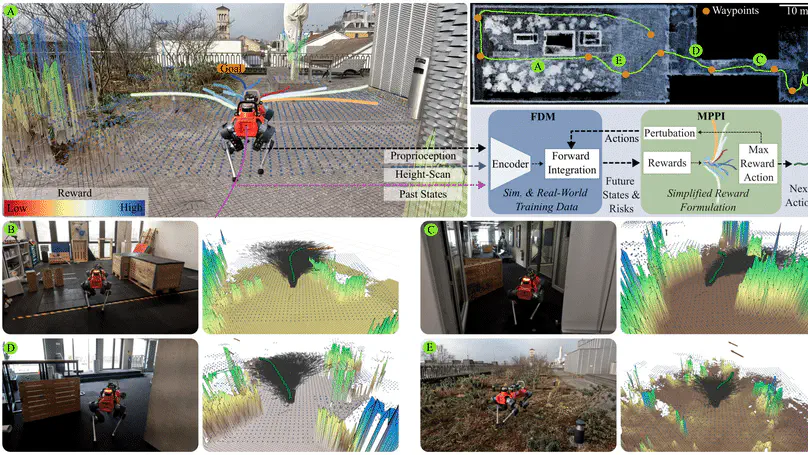
My research focuses on learning-based navigation and autonomy for legged robots, with particular interest in perceptive planning, forward dynamics models, and sim-to-real transfer. I develop methods that allow robots to reason about physical interactions with complex terrain, enabling safer and more capable autonomous navigation in unstructured environments.
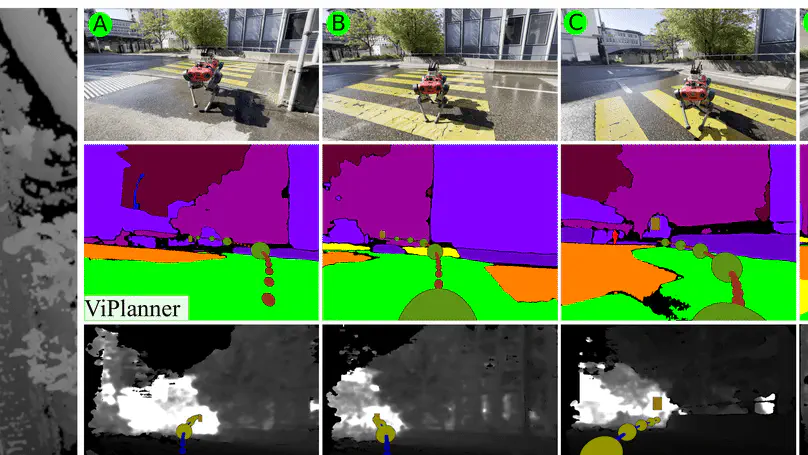
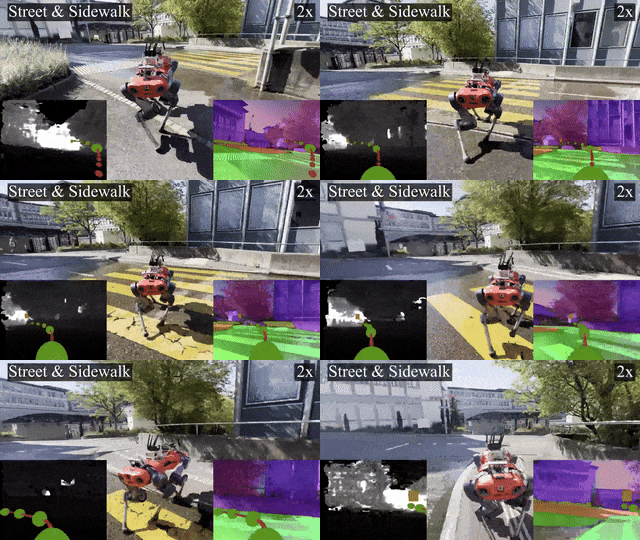
Prior to my PhD, I completed an M.S. in Mechanical Engineering at ETH Zurich (GPA: 5.70/6), where my thesis introduced ViPlanner — a visual-semantic local navigation framework demonstrating zero-shot sim-to-real transfer on ANYmal. I also hold a B.S. with Honours from TU Darmstadt.
- Robotic Navigation & Autonomy
- Robot Learning (RL / Imitation)
- Simulation & Sim-to-Real Transfer
PhD in Robot Learning
ETH Zurich
MSc in Mechanical Engineering, 2023
ETH Zurich
BSc in Mechanical Engineering, 2020
TU Darmstadt

Experience


Education


Featured Publications
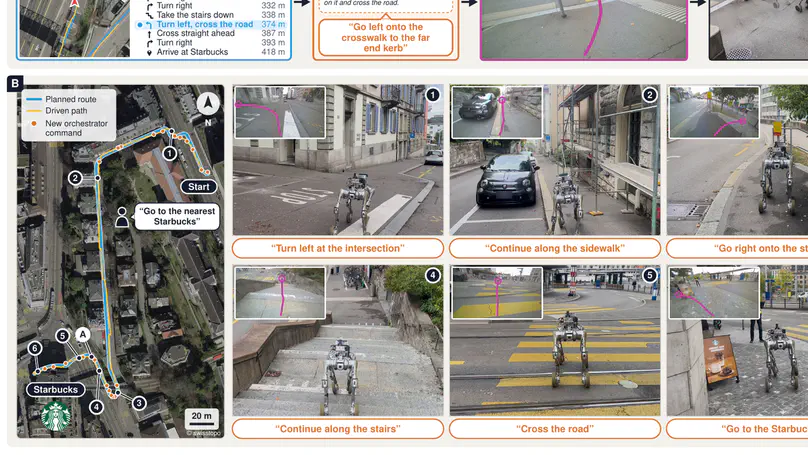
Web services provide walking directions for nearly every city, but following them reliably over long routes remains challenging for autonomous robots. Point-goal navigation policies rely heavily on accurate GNSS, while most vision-language navigation models struggle to execute even short instructions outdoors. We present WayTrace, a hierarchical system that connects web-map directions to robot motion through language. An off-the-shelf orchestrator vision-language model reads the turn-by-turn directions, a satellite map and recent camera images, and issues one atomic language command at a time, such as ‘cross the road to the left’. An onboard trace predictor, trained on over one million automatically labelled samples from street-level images, draws the path for this command in the image, and a reinforcement learning policy tracks it. In long-range simulated missions, WayTrace remains robust to GNSS noise and rarely leaves crosswalks or sidewalks, while point-goal baselines degrade sharply with about ten times more violations. Deployed on a wheeled-legged robot, WayTrace completes real-world missions of up to 1.37 km at about 1.1 m/s through a busy city centre, rural trails and a university campus, handling crosswalks, staircases and construction sites. Project page: https://way-trace.github.io
Recent Publications
Projects

Contact
- rothpa@ethz.ch
- Leonhardstrasse 21, Zurich, 8092
- Message Me